When exterior log staining can happen in Jackson Hole
Product labels want log surfaces at 40°F or warmer, and Jackson's normal lows sit near freezing in May and September. That leaves a short summer window, and this guide shows the numbers behind it.
No law sets a staining season in Jackson Hole. The limits come from the products. Log stains and chinking sealants carry temperature and moisture limits on their labels, and at about 6,200 feet those limits leave a short window. Set the labels next to NOAA's normals for Jackson and you can plan prep, chinking, and stain, and book the work early enough.
What the labels require
Two common product lines publish their limits:
- Perma-Chink Systems rates its Lifeline stains, Lifeline Advance, and Log & Timber Defense for 40°F to 90°F. Its application guidance recommends 40°F to 90°F for its sealants, though Woodsman's label states 40°F to 120°F and the Perma-Chink and Energy Seal labels give no upper limit.
- Sashco Capture log stain: its current data sheet requires air and surface temperatures of 40°F to 90°F through the rest of the day after application, including overnight.
Perma-Chink's sheet makes two more points that matter here. "We are concerned with surface temperatures, not air temperatures." And: "The one thing you never want to do is attempt to stain logs that are frozen." It names 50°F to 80°F as the range where its finishes go on most easily.
Sashco adds conditions beyond temperature. Logs need a moisture content of 19% or less. Stain should go on no more than 2 weeks after prep is complete. And Sashco says to stain when the forecast is clear and free of rain and snow for the rest of the day, and to protect stained walls from direct rain for 1 to 2 days if rain can't be avoided.
Other brands have their own limits. Ask your contractor which product they plan to use and read its label.
What Jackson's climate does
NOAA's 1991–2020 normals for the Jackson weather station give the average daily high and low for each month. The station sits at about 6,210 feet.
| Month | Normal high (°F) | Normal low (°F) | Nights at or below freezing |
|---|---|---|---|
| April | 50.2 | 25.8 | 24.6 |
| May | 60.3 | 31.5 | 16.4 |
| June | 69.8 | 37.8 | 6.0 |
| July | 79.1 | 41.4 | 1.6 |
| August | 78.0 | 39.8 | 3.2 |
| September | 68.1 | 32.8 | 15.1 |
| October | 54.5 | 24.9 | 25.0 |
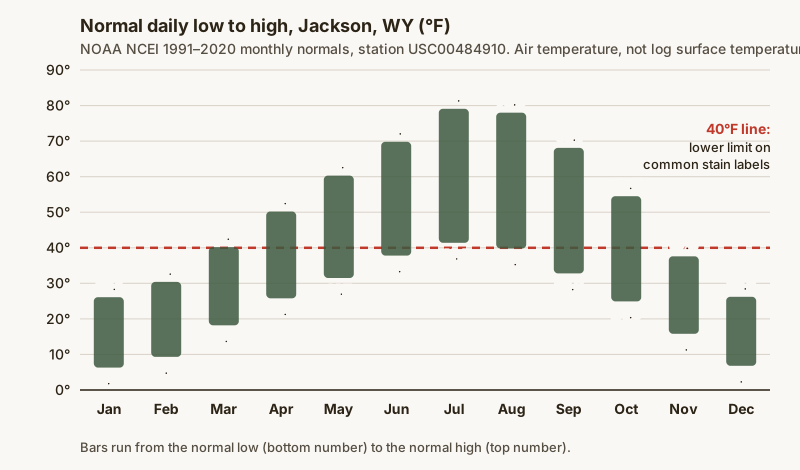
Over a full year, the station averages about 236 nights with a low at or below freezing and about 61 days when the high stays at or below freezing.
Reading the table
June through August is the main window under Perma-Chink's limits, which apply to the log surface during application. Normal lows run from 37.8°F in June to 41.4°F in July, and normal highs from 69.8°F to 79.1°F, which puts most of the day inside that range. Sashco Capture also needs nights at or above 40°F, which Jackson's normals reach only in July on average. July's normal high sits near the 80°F top of Perma-Chink's easy range, and the label limits refer to the log surface, not the air.
May and September are shoulder months. Normal lows sit near freezing, at 31.5°F in May and 32.8°F in September, and NOAA counts about 16 nights at or below freezing in May and about 15 in September. Work can happen on warm afternoons, but logs that froze overnight need time to thaw and warm before any stain goes on.
October through April is closed for exterior staining in most years. Normal October lows fall to about 25°F, and normal April highs reach only about 50°F.
This reading comes from averages and labels, and any given year will differ. A warm week in late September can work. A cold, wet June can stall a job.
Daily swings and the time of day
Summer nights and days differ a lot here. NOAA puts Jackson's average daily range at about 36°F in June through August. July's normal low of 41.4°F sits a degree and a half above the 40°F label minimum, so a cool morning can start below it, and stain waits for the logs to warm.
It also affects chinking. Perma-Chink says never to apply sealant in direct sunlight, so on a sunny day the work moves around the house with the shade. A south or west wall may only be workable early or late.
Cure time and the end of the season
Chinking takes time to cure. Perma-Chink says its sealants may take a few weeks to cure in summer and a couple of months in winter. Stain also needs dry weather afterward: Sashco notes that in severe conditions, below 40°F or above 70% humidity, Capture takes longer to reach full rain resistance.
So the season ends before the last warm day. Chinking done in late September has less warm weather to cure before the snow. If the scope includes heavy chinking, put it early.
Planning the job
Working backward from the window:
- Winter or early spring: Get the condition check and quotes. Ask about permits if any log repair is involved. The permits guide lists who to call.
- Late spring: Agree on a start date and the products. Ask how the contractor handles weather days.
- Early summer: Strip or blast, then let the logs dry. Sashco's 2-week limit between prep and stain means the two go close together.
- Midsummer: Repair, chink, and stain.
- Late summer: Finish touch-ups before nights cool off in September.
Interior work runs year-round
Interior walls don't face these limits in the same way, because the house is heated. Interior refinishing is the one log job that fits the winter months.
When stain doesn't soak in
Each manufacturer sets its limits for its own product. The Wood Handbook from the USDA Forest Products Laboratory describes what happens when a penetrating stain fails to soak in: it leaves a surface film, and thin films may crack and peel within a year or two. Redoing a wall costs more than waiting a day for the logs to dry or warm.
For what sun and freezing do to the finish once it's on, read the weathering guide. When you're ready to plan a summer, send a request.
Sources
- NOAA NCEI: 1991–2020 Monthly Normals, Jackson, WY (USC00484910)
- NOAA NCEI: 1991–2020 Annual/Seasonal Normals, Jackson, WY (USC00484910)
- Perma-Chink Systems: Application Temperatures (2025)
- Sashco: Capture Log Stain Technical Data Sheet (2025)
- USDA Forest Products Laboratory: Wood Handbook (FPL-GTR-282), Chapter 16, Finishing Wood
Rules, rates, and costs change. Confirm details with the agency or a qualified professional before you act on them.
Send a request
This site publishes planning information and does not perform log home work. A request sent here goes to an independent local contractor, who may contact you about it.
(307) 284-4423 Send a log home requestKeep reading
-
How sun at altitude and freezing wear a log finish
UV gets stronger with elevation and bounces off snow, and Jackson's lows drop to freezing or below on about 236 nights a year. This guide covers what that does to wood and finish, and where to look on your own walls.
-
Do you need a permit to stain or re-chink a log home?
Whether staining needs a permit depends on which office has the parcel. Log replacement is a different question. This guide lists who to ask and what each office has published.
Planning work on a log home?
Describe the home and what it needs. The request goes to an independent local contractor.
Towns covered
- Jackson
- Jackson Hole
- Wilson
- Teton Village
- Driggs, ID
- Victor, ID
Landmarks
- Grand Teton National Park
- Jackson Hole Mountain Resort
- Town Square
- National Museum of Wildlife Art
- Snake River