Caring for a log home in Jackson Hole
Staining, chinking, and log repair at about 6,200 feet: what sun and cold do to a log wall, when the work can happen, and who to ask about permits, drawn from county, NOAA, and manufacturer sources.
| JJan | FFeb | MMar | AApr | MMay | JJun | JJul | AAug | SSep | OOct | NNov, current month | DDec | |
|---|---|---|---|---|---|---|---|---|---|---|---|---|
| Exterior staining and chinking | ||||||||||||
| Exterior staining and chinking | outside the typical window | outside the typical window | outside the typical window | outside the typical window | possible | typical | typical | typical | possible | outside the typical window | outside the typical window | outside the typical window |
| Normal nightly low at or above 40°F | ||||||||||||
| Normal nightly low at or above 40°F | outside the typical window | outside the typical window | outside the typical window | outside the typical window | outside the typical window | outside the typical window | typical | outside the typical window | outside the typical window | outside the typical window | outside the typical window | outside the typical window |
- Typical
- Possible
Based on NOAA's 1991–2020 monthly normals for Jackson and the 40°F to 90°F log surface range on common log stain labels. Weather and the product label set the actual dates.
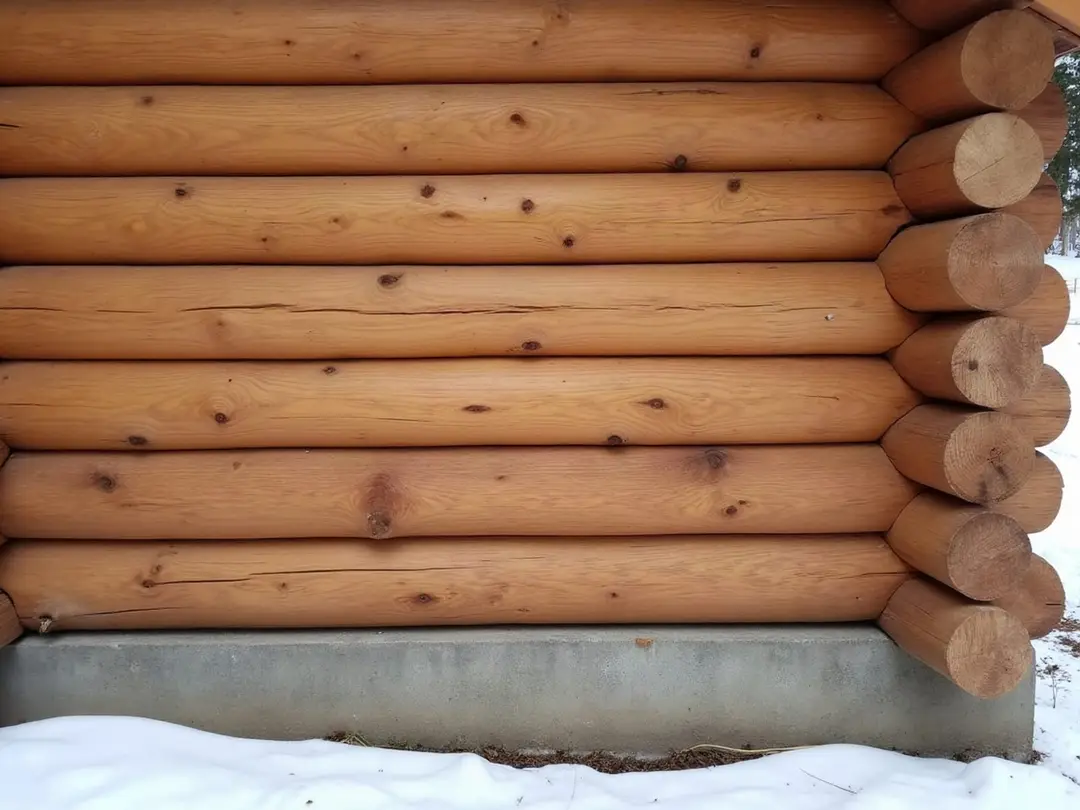
In a full-log home, the log wall is the structure and the siding at once. No sheathing or house wrap sits behind it, so once the finish wears through, the logs take the sun, snow, and meltwater themselves. In Jackson Hole and Teton Valley, refinishing is maintenance on the walls that hold the house up, and the climate decides when you can do it.
This site gathers what you need before you call a contractor: how the work is done, when it can happen at this elevation, which office handles permits for which town, and what to ask before you sign. Each guide lists its sources.
Reading your walls
Walk the house on a dry day. Start with the south and west walls, then check the lower courses on every side. Note these before anyone prices the job:
- Gray or silver wood. The USDA Forest Products Laboratory's Wood Handbook calls gray, weathered wood "severely sunburned": UV light has broken down the lignin that holds the surface cells together.
- Checks that face up. A log cracks along its length as it dries, and that's normal. A crack on the top of a log can hold water.
- Log ends. The Wood Handbook says liquid water enters end grain 10 to 100 times faster than the other faces, so check the log ends at the corners and under the eaves.
- Chinking that has pulled away from a log on one side, or split down the middle.
- Soft spots. Press a screwdriver into the lowest course and the logs below windows. If it sinks in, the job may include log repair as well as finish work.
Planning around the season
The window for exterior staining and chinking is short here. Perma-Chink and Sashco labels call for log surface temperatures of at least 40°F, and NOAA's 1991–2020 normals put Jackson's average low near freezing in both May and September. The product decides how much of the summer that leaves. Perma-Chink's limits apply to log surface temperature during application, while Sashco Capture also needs nights at or above 40°F, which Jackson's normals reach only in July on average. If you get the condition check and quotes done in spring, or the fall before, you have more room to pick dates. The staining season guide has the month-by-month numbers.
What it costs
This site couldn't find a public dataset or three agreeing independent sources for refinishing labor here, so it doesn't publish a labor range. Materials can be priced. Perma-Chink's June 2026 list price for its Lifeline Ultra-2 stain is $119.99 a gallon, and at the company's stated coverage rates, two coats on 1,000 square feet of log wall take about $417 to $543 of that stain. Its July 2026 list price for a 5-gallon pail of Perma-Chink sealant is $299.99, which it says covers almost 259 linear feet of a 1-inch joint. Prep, access, chinking labor, and any log repair make up the rest of a quote, so ask each contractor to price those as separate lines. Then you can compare bids line by line.
Where to start
- Permits for staining and chinking, by town
- Hiring a contractor: license, registration, and insurance questions
- What sun and cold do to a log finish
- The kinds of work and how a restoration usually runs
- Which office issues permits in each town
When you know what the house needs, send a request and it goes to an independent local contractor.
Local conditions
Checked October 2026
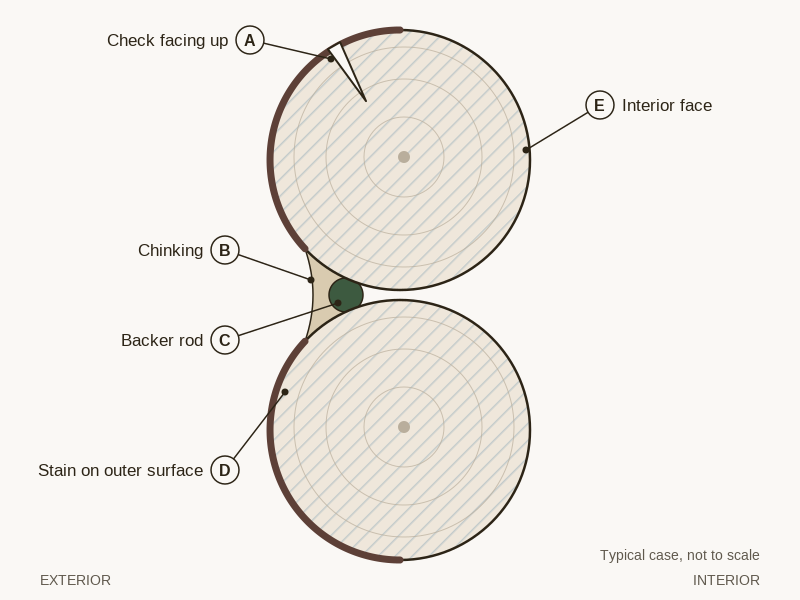
Inside a log wall joint
Logs dry and crack along their length; these cracks are called checks, and one that faces up can hold water. Between courses, chinking bridges the gap, with foam backer rod behind it to set its depth so the sealant can stretch as the logs move. Stain sits on the outer surface and takes the sun.
- A
- A check that faces up and can hold water
- B
- Chinking, bridging the gap between logs
- C
- Foam backer rod, setting the depth of the chinking
- D
- Stain on the outer log surface
- E
- The interior face of the wall
What wears a log finish here
- Sun at altitude
- The World Health Organization's rule of thumb is about 10% more UV for every 1,000 meters of elevation, and snow can reflect up to 80% of UV. Jackson sits at about 6,200 feet, roughly 1,900 meters.
- A long freezing season
- NOAA's 1991–2020 normals for the Jackson station show the low dropping to freezing or below on about 236 nights a year, and the high staying at or below freezing on about 61 days.
- A short window for exterior work
- Common log stain labels, and Perma-Chink's sealant guidance, call for log surface temperatures between 40°F and 90°F. Normal lows in Jackson sit near freezing in May and September, so exterior finish work typically clusters in summer.
- Weathering and termite ratings in the code
- Teton County, Wyoming's adopted building code design criteria rate weathering as severe, a rating that sets requirements for concrete and masonry, and termite risk as none to slight.
How the work usually runs
-
Condition check
A contractor typically starts by looking at the finish, the chinking joints, checks on upward-facing log surfaces, and the log ends and lower courses where water tends to sit.
-
Surface preparation
Old finish and grayed wood come off by media blasting (corn cob or glass), chemical stripping, or sanding. Sashco's Capture data sheet says to stain no more than 2 weeks after prep is complete.
-
Chinking and sealing
Failed chinking is cut out and replaced, with foam backer rod setting the joint depth. Perma-Chink's sealant guidance calls for log surfaces between 40°F and 90°F and no application in direct sun.
-
Staining
Sashco's Capture data sheet calls for log moisture of 19% or less, and air and surface temperatures of 40°F to 90°F through the rest of the day, including overnight. It says to stain when the forecast is clear of rain and snow for the rest of the day. Logs should never be stained while frozen.
-
Upkeep
After the work, a yearly look at log ends, lower courses, and chinking joints helps catch wear before it reaches bare wood.
Planning guides
Each guide covers one part of caring for a log home in Jackson Hole or Teton Valley and lists the sources behind its facts.
-
Hiring a log home contractor in Jackson Hole and Teton Valley
Wyoming and Idaho handle contractors differently. This guide covers the Town of Jackson license, Idaho's registration law, the exemptions, and what to get in writing.
-
How sun at altitude and freezing wear a log finish
UV gets stronger with elevation and bounces off snow, and Jackson's lows drop to freezing or below on about 236 nights a year. This guide covers what that does to wood and finish, and where to look on your own walls.
-
When exterior log staining can happen in Jackson Hole
Product labels want log surfaces at 40°F or warmer, and Jackson's normal lows sit near freezing in May and September. That leaves a short summer window, and this guide shows the numbers behind it.
Common questions
Do I need a permit to stain or re-chink a log home?
Staining and refinishing are generally treated as finish work. Teton County, Wyoming's building code resolution and the City of Driggs both list exterior painting and similar finish work as not needing a building permit, though the county calls its table a guideline only. Replacing logs or repairing structural rot is different and may need a permit. Check with the jurisdiction for the property: Town of Jackson Building Department (307-733-0440 ext. 1352), Teton County, WY (307-733-7030), City of Driggs (208-354-2362), City of Victor (208-274-7082), or Teton County, ID (208-776-8171).
When can exterior staining happen in Jackson Hole?
Product labels set the limits, and they differ by product. Perma-Chink's stain labels call for log surface temperatures between 40°F and 90°F during application, and Perma-Chink warns never to stain frozen logs. Sashco's Capture data sheet requires air and surface temperatures of 40°F to 90°F for the rest of the day after application, including overnight. NOAA's normals for Jackson put the average May and September lows near freezing. Capture's overnight rule leaves a narrower window.
What does elevation do to a log finish?
UV gets stronger with altitude. The World Health Organization's rule of thumb is about 10% more UV per 1,000 meters, which puts Jackson, at roughly 1,900 meters, near 19% above sea level. Snow adds to it: WHO says snow can reflect up to 80% of UV, and the EPA says snow can nearly double UV strength in winter. UV breaks down the lignin that holds wood fibers together, and it degrades finishes.
What is the difference between media blasting and chemical stripping?
Media blasting uses crushed corn cob, glass, or similar material under air pressure to take off old finish and grayed wood. Chemical strippers soften the finish so it can be washed off, and they have their own temperature limits: Perma-Chink lists StripIt at 55°F to 90°F. Either way, the logs have to dry before stain goes on.
Does a contractor need a license for log home work here?
Inside Jackson's town limits, ask the Town. In Idaho, contractors must register with the state under Idaho Code 54-5204, with exemptions that include a single project under $2,000. Ask any contractor for the license or registration number and a certificate of insurance.
Do wildland-urban interface rules apply to log homes?
Since January 1, 2025, every private parcel in the Town of Jackson and Teton County, Wyoming falls under the 2024 Wildland-Urban Interface Code. Re-roofs and interior-only projects don't need a WUI permit. Log or siding replacement can raise WUI questions, and Jackson Hole Fire/EMS handles WUI permits.
What if the home is on the Jackson Historic Register?
Listing on the Jackson Historic Register is voluntary and requires the owner's consent. A listed property needs a Certificate of Appropriateness from the Town for any significant change, so ask the Town of Jackson before changing materials or appearance.
Planning work on a log home?
Describe the home and what it needs. The request goes to an independent local contractor.
Towns covered
- Jackson
- Jackson Hole
- Wilson
- Teton Village
- Driggs, ID
- Victor, ID
Landmarks
- Grand Teton National Park
- Jackson Hole Mountain Resort
- Town Square
- National Museum of Wildlife Art
- Snake River